
Note: In this series, I intentionally avoid equations and code, because model selection is primarily a conceptual decision, not a programming one.
Before we choose the AI model that suits our usage, we need to discuss a very fundamental foundation: How does the AI actually see the data?
To understand this, we must introduce our first core concept: “Time Series."
What is "Time Series"?
In short: “Events compared to time. “
Yes, that is the whole definition. But the important part is why we care. In the real world, the information we feed into a model almost always arrives in a sequence that depends on time.
graph TD
    %% Input Features
    subgraph Properties [Time Series Attributes]
        M{Memory}
        F[Frequency]
        L[Latency]
    end

    %% Memory Branch
    M -->|High Auto-correlation| TS_F[Forecasting]
    M -->|Pattern matching| TS_C[Classification]

    %% Frequency & Latency Branch
    F -->|High Sampling| RT[Real-time Analysis]
    L -->|Low Latency| RT

    RT -->|Detection| TS_C

    %% Relationships
    TS_F -->|Predictive| Goal1[Future Trends]
    TS_C -->|Diagnostic| Goal2[Event Recognition]

    %% Styling
    classDef attr fill:#2d3748,stroke:#facc15,stroke-width:2px,color:#fff;
    classDef process fill:#1a1a1a,stroke:#facc15,stroke-width:2px,color:#fff;
    class M,F,L attr;
    class TS_F,TS_C,RT process;
The Video Example
Think about a standard video. A video running at 24 frames per second actually consists of:A sequence of 24 individual pictures every single second.
A stream of audio that is locked into that same time frame.
If you shuffle those 24 pictures, the “video” disappears and becomes a mess.
The AI needs to understand that Frame #2 comes after Frame #1. Without the “Time Series” logic, the AI is just looking at random photos; with it, the AI can actually understand action and movement.
So, what happens next?
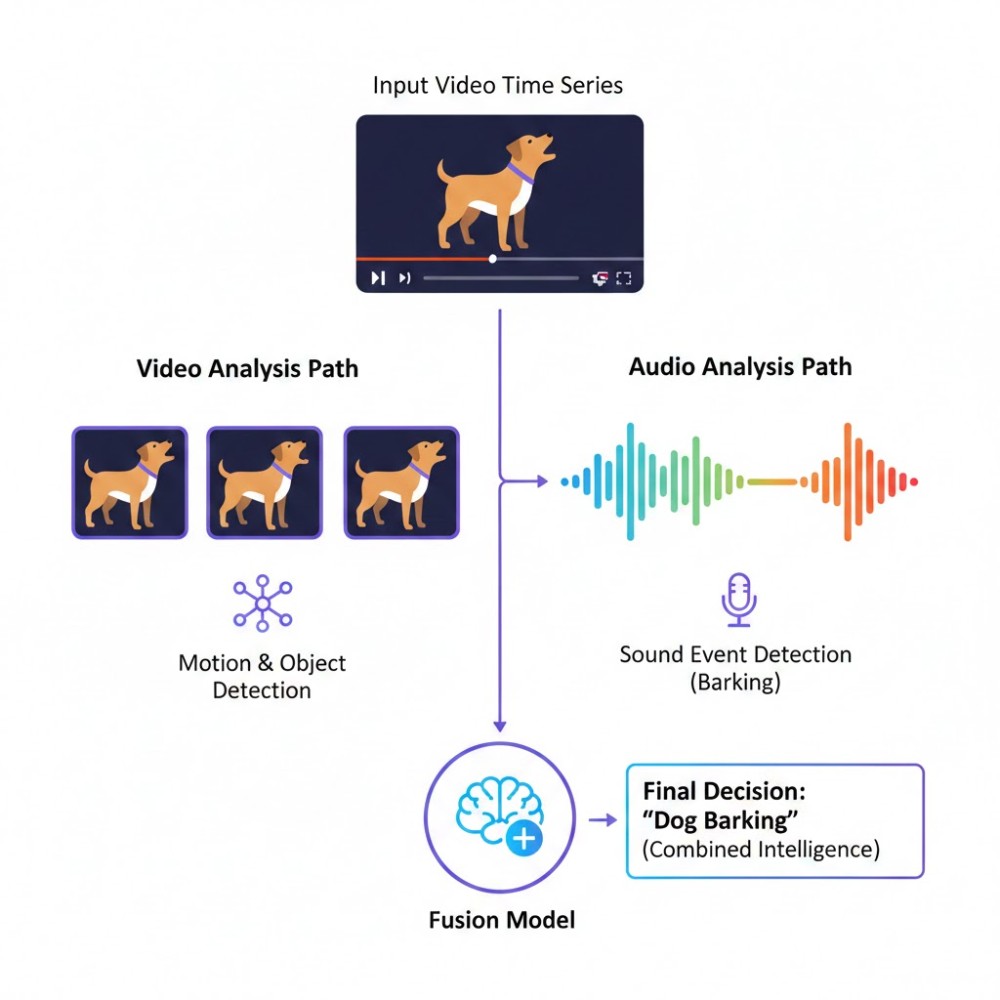
Once we have our data, the AI needs to actually understand what is happening inside that sequence of pictures and audio.To do this, the AI follows a “divide and conquer” strategy:
1. The Specialized Detectors
First, we need the model to identify what is in the pictures and what is in the sound. We run two processes at once:
- The Vision Side: The model tracks the time series of images to see what changes between each frame. If a person is in Frame A and moves in Frame B, the model detects that motion.
- The Audio Side: At the exact same time, another part of the model detects and analyzes the sound.
2. Breaking Down the Complexity
To simplify the process, the AI doesn’t usually look at the whole picture at once. Instead, it breaks the picture into smaller pieces that are easier to process. After it understands what is happening in each small piece, it combines them back together to get the full story.
3. The Final Merger
In the end, a third model takes the results from both the “eyes” (vision) and the “ears” (audio) and combines them. This is how the AI concludes exactly what is happening—for example, matching the sound of a “splash” with the visual of someone jumping into a pool.
What is your goal?
Now that we understand how the AI sees the "Video + Audio" sequence, we have to ask a very important question: What do we want the AI to do with this information?Even though the data is the same, we usually use Time Series for two different goals:
Forecasting (Predicting the Future): This is when we look at the sequence to guess what happens next. Like looking at the last 10 minutes of a video to guess where the car will be in the next 5 seconds.
Classification (Understanding the Present): This is when we look at the sequence to label what is happening right now. For example: “Is the person in this video running, or are they dancing?”
Why "Frequency" Matters
Before we pick a model, we must also look at the “Heartbeat” of our data.
- A video has a very fast heartbeat (24 frames every second).
- A weather report might have a slow heartbeat (one measurement every hour).
The model you choose for a “slow” heartbeat will be very different from the one you choose for a “fast” video. If you use a massive, complex AI for a simple weather report, you are wasting power. But if you use a simple math model for a complex video, it will fail.
The video and audio example is just one way a Time Series can work. We can apply this same logic to almost any kind of data:
- Finance: Stock prices or Forex movements.
- Healthcare: A patient’s heartbeat synced with their blood pressure and oxygen levels.
- Weather: Temperature, wind speed, and humidity tracked over a week.
In all these cases, the “secret” is the same: the data only makes sense when it is in the correct order. However, for this first part of the series, our goal was simply to answer: “What is Time Series?" Now that we have the foundation, we are ready to move on to the actual models.
We started with a simple question: What is Time Series? We now know it isn’t just a list of numbers; it has a “backstory” told through time. Whether it’s the stream of 24 frames in a second of video or the beat of a heart in a hospital, the order is what gives the data its power.
If you understand that “Time” is the anchor for all this information, you have already understood the hardest part of AI logic.
But knowing what it is is only half the battle. The next challenge is: How do we handle it? In Part II, we will dive into the “Brain” of the AI. We will talk about why some models have “memories” while others only live in the moment, and I will show you the Decision Matrix to help you choose the perfect AI model for your project.